Momentum (AQA 3.4.1.6) — Handout + Slides + Notes
How to use this file
---separates slide boundaries.- Student-facing content is suitable as a handout.
- Teacher-only notes use
> [!teacher] ....- Student-facing history asides use
> [!history] ....
Momentum: conserved motion with direction
AQA A Level Physics (3.4.1.6)
Lower Sixth • 35 minutes
Learning objectives
- Define momentum: (vector; units).
- Apply conservation of momentum in 1D for an isolated/approximately isolated system.
- Use and interpret impulse as area under an - graph.
- Distinguish momentum conservation from kinetic-energy conservation.
Key vocabulary
- vector (magnitude + direction), scalar (magnitude only)
- system, external force, internal force
- impulse, elastic, inelastic
What you already know vs what is new today
Already covered (3.4.1.1—3.4.1.5 and 3.4.1.7—3.4.1.8)
- Core mechanics language: vector/scalar, components, sign conventions, units.
- Kinematics basics: , , and interpreting velocity–time graphs (including “area under graph” reasoning).
- Rate-chain recap: over time gives , and over time gives .
For interested students only: over time is jerk (not required for this lesson/spec point). - Newton’s laws, especially for constant mass and free-body diagrams. ([aqa.org.uk][1])
- Work/energy: , , power ideas. ([aqa.org.uk][1])
New in 3.4.1.6 (today)
- Momentum defined and used as a conserved quantity.
- Impulse and force as rate of change of momentum , and for constant , .
- Force–time graphs: area under the curve as impulse.
- Applying conservation of momentum quantitatively in 1D; elastic vs inelastic; explosions; “impact time reduces force” contexts. ([aqa.org.uk][1])
One key judgement call for the interview
Prioritise (A) conservation in 1D and (B) impulse = area under -. These are the most “AQA-visible” outcomes for 3.4.1.6. ([aqa.org.uk][1])
Introduction: symmetry suggests which quantities matter
Reversing direction changes .
But squaring removes direction: .
So it is natural that:
- momentum is linear in because it tracks direction;
- kinetic energy is proportional to because it ignores direction.
Symmetry helps justify why energy uses .
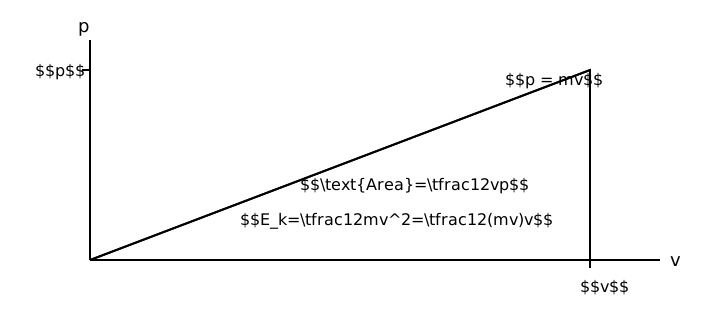
The factor is not explained by symmetry; it comes from geometry of areas under graphs, later.
A debate about “what counts as motion”
For a long time (especially in the 18th–19th centuries) there were serious arguments about the “true measure of motion” in impacts: should it be something like (directional) or something like (non-directional)? Those debates mattered during the industrial revolution, when engines, collisions, and efficiency were practical concerns and “fundamental laws” could bring reputation, patronage, and influence. Engels’ Dialectics of Nature discusses “laws of motion” in this period—when it was not culturally obvious which quantities were the right foundations.
Textbook core 1: momentum and mass
Momentum
[ \mathbf{p}=m\mathbf{v} ]
- Units:
- Momentum is a vector (direction matters).
1D sign convention: choose a positive direction and use signs for velocities.
Mass as proportionality (and as “quantity of matter”)
In this topic we can treat mass as the constant of proportionality between and :
[ p \propto v \quad\Rightarrow\quad p = mv. ] Experiments with ordinary matter show something stronger: mass is also (very nearly) a conserved property of matter in everyday mechanics, used as a measure of “quantity of matter”.
Aside: directional motion is vector motion, whereas “amount” without direction is scalar motion.
Textbook core 2: conservation of momentum
Conservation law (1D)
If the resultant external force on a system is zero (or external impulse is negligible during the interaction),
[ \sum p_{\text{before}} = \sum p_{\text{after}}. ]
What “system” means
A system is the collection of objects you decide to include in the momentum balance (e.g., two trolleys together).
- Internal forces act between objects inside the system (they come in equal and opposite pairs).
- External forces come from outside the system (track friction, a hand pushing, gravity components along the track).
Momentum conservation is strongest when external forces are negligible during the short interaction.
Textbook core 3: force, impulse, and graphs
Newton’s second law in momentum form
[ F=\frac{dp}{dt}. ] Definition: Impulse is the change in momentum,
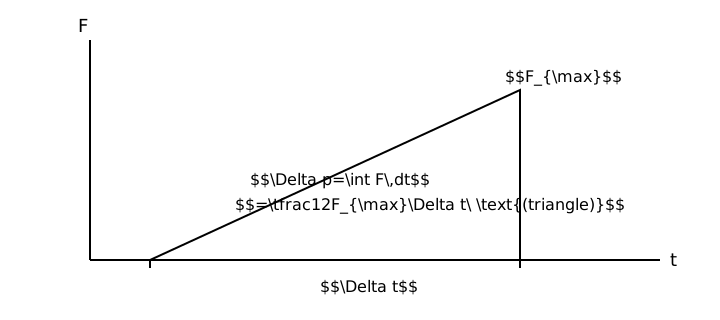
[ \text{Impulse} \equiv \Delta p. ] For (approximately) constant force over ,
[ \Delta p = F\Delta t. ] More generally,
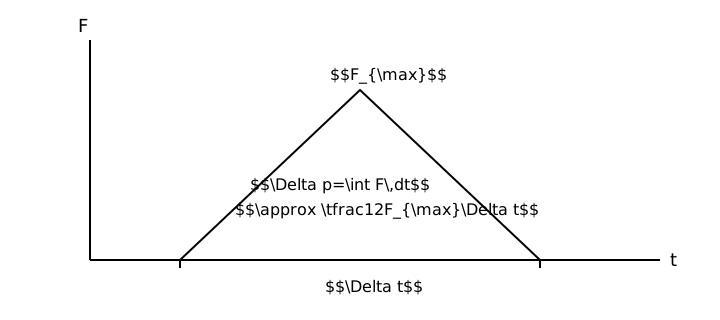
[ \Delta p=\int F,dt. ]
Graph meaning (exam gold)
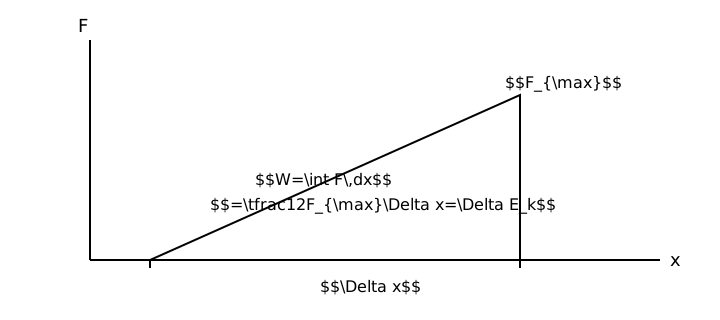
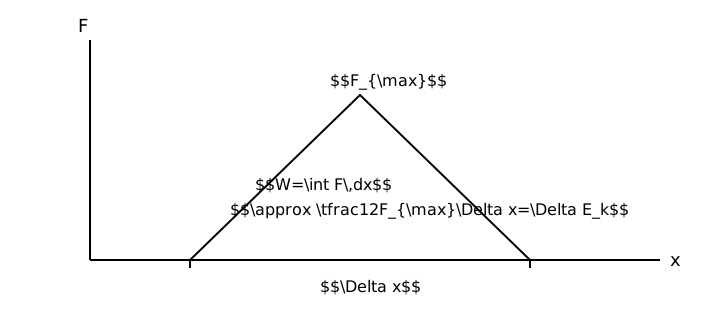
- On an - graph, area (impulse).
- On a - graph, gradient .
What we will do in 35 minutes (lesson spine)
- Warm-up diagnostic (3–4 min): quick questions to activate prior knowledge.
- Define momentum (5 min): , vector and units; why it’s different from energy.
- Conservation in 1D (12–15 min): one model example + pupil practice (stick then rebound).
- Impulse (8–10 min): ; force–time area; “increase impact time, reduce force”.
- Exit check (2 min): one conservation question + one impulse-from-graph question.
Why this ordering works
It aligns to the spec and uses the demo as “evidence” rather than a fragile dependency.
Warm-up diagnostic questions (3—4 minutes)
- A object at : what is ?
- If the resultant force is zero, what can you say about velocity?
- Sketch what a large force over a short time might look like on an - graph.
Aim of the warm-up
Elicit (i) , (ii) Newton 1, (iii) readiness for “area under graph” reasoning.
Board plan (teacher script, left → right boards)
BOARD 1 (0:00–0:04) — Title + Do Now
Write:
- Momentum (AQA 3.4.1.6)
Aim: define momentum, use conservation in 1D, link to impulse.- Do Now:
- . Find .
- If , what happens to velocity?
- State Newton 2 in symbols.
Script: “Start Do Now.” Circulate; cold call.
Feedback: ; velocity constant; (tease ).
BOARD 2 (0:04–0:09) — Definition, units, sign convention
Write:
- ; units ; vector
- Choose direction; signs on velocities
- Quick check: kg, m/s →
Script: prediction questions: double or doubles . Add: compare vs : same can have different , and vice versa.
BOARD 3 (0:09–0:14) — Demo + conservation condition
Write:
- If :
- Condition: short collision ⇒ external impulse small ⇒ total momentum constant
Demo: stick collision; read and . Round; emphasise “close supports model”.
BOARD 4 (0:14–0:24) — Conservation engine + worked example + practice
Write:
- If :
- Method: direction → totals → solve
- Worked:
- Practice A: stick →
- Practice B: rebound
Optional extension (if flying): explosion-from-rest: momenta equal and opposite.
BOARD 5 (0:24–0:31) — Impulse and -
Write: ; area under -; triangle Script: crumple zones/catching with “give”.
BOARD 6 (0:31–0:35) — Energy link + exit + summary
Write: .
Exit: , .
Summary bullets.
Experimental results (demo table)
| Trial | (kg) | (kg) | (m s) | (m s) | (m s) | (kg m s) | (kg m s) |
|---|---|---|---|---|---|---|---|
| 1 | 0.50 | 0.50 | +0.80 | 0.00 | +0.41 | ||
| 2 | 0.50 | 0.50 | +1.10 | 0.00 | +0.56 |
Interpretation: agreement won’t be perfect (friction, alignment, sensor noise). “Close” is evidence for the conservation model during the short interaction.
Textbook fill: standard collision outcomes
Inelastic vs elastic
- Inelastic collision: momentum conserved (if isolated), kinetic energy decreases (converted to heat/sound/deformation).
- Perfectly inelastic: objects stick together (maximum kinetic energy loss consistent with momentum conservation).
- Elastic collision: momentum conserved and kinetic energy conserved (idealised; approximately true in some interactions).
Important: momentum conservation depends on external forces, not on whether the collision is elastic. ([aqa.org.uk][1])
Explosions (useful extension)
If a system starts at rest and explodes into two parts, total momentum is still zero:
[ p_1 + p_2 = 0 \quad\Rightarrow\quad p_1 = -p_2. ] This is a clean “direction matters” example.
Textbook fill: common mistakes (and how to avoid them)
- Forgetting direction: always set a positive direction and keep signs.
- Conserving momentum for the wrong system: include all interacting objects; exclude the hand pushing.
- Mixing up graphs:
- -: area is .
- -: gradient is .
- Assuming kinetic energy is conserved: only in elastic collisions.
Questions to test understanding
Quick checks
- Why is momentum a vector? Give a 1D example where the sign matters.
- Show dimensionally: and has the same units.
- What assumption are you making when you apply momentum conservation to two trolleys on a track?
- On an - graph, what does the area represent?
Short problems
- Stick collision: kg at m/s hits kg at rest and they stick. Find .
- Rebound: kg at m/s hits kg at rest. After, m/s. Find .
- Impulse: approximate a triangular force pulse with lasting . Estimate .
Conceptual
- Two pulses have the same area but different peaks. What is the same physically? What differs?
- Why does increasing collision time reduce injury risk if is fixed?
Practical/apparatus notes (low risk, high payoff)
If you want apparatus, the most interview-efficient is something that makes the collision story concrete without setup risk:
- two low-friction trolleys with Velcro/magnets for “stick together” collisions; and/or
- a motion sensor/light gates to measure before/after velocities.
If the lesson is fully runnable without apparatus, the demo becomes an enrichment/evidence moment rather than a dependency.
Interactive trolley simulation
Momentum & Collisions
Interactive Physics Simulation (AQA 3.4.1.6)
Parameters
Controls
Impulse applied before collision: Jext = Fext × Δt to the active trolley system.
Sets how often graph points are recorded. Physics still runs at a fixed 100 Hz.
Force vs Time
Position / Velocity / Acceleration / Jerk
| State | Time (s) | v₁ (m/s) | v₂ (m/s) | p_total (kg·m/s) | K_total (J) |
|---|---|---|---|---|---|
| Initial | 0.00 | 0.00 | 0.00 | 0.00 | 0.00 |
| Final | — | — | — | — | — |
| % Change | — | — | — | — | — |
Figure 7: Use this interactive model to rehearse momentum-conservation setups before or after the physical trolley demo.
Further thoughts (beyond syllabus): curved - and “effective mass”
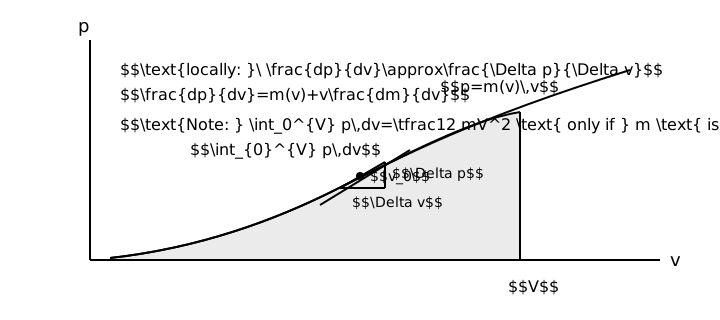
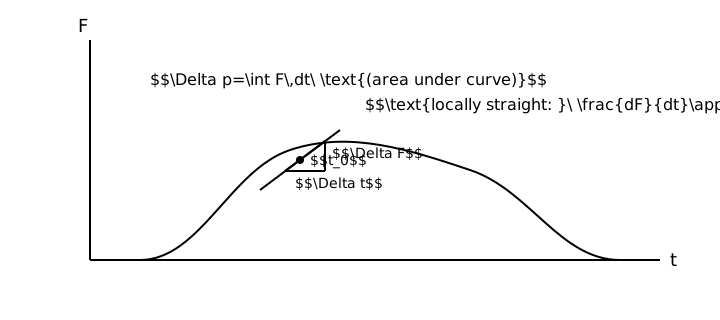
Figure 8: Curved - with local linearisation and shaded . If , slope need not be constant. The shaded area is well-defined, but it is not automatically unless is constant.
What could it represent? (suggestions)
- A system gaining/losing mass as it moves (e.g. collecting material).
- A situation where the simple model “one constant ” isn’t adequate across the whole range (you would test what extra physics is missing).
Thinking exercises
- If the curve bends upward (slope increasing with ), what does that suggest about ?
- How would you estimate the local slope near using a small – triangle?
- Why is it risky to label the shaded area “kinetic energy” in the variable-mass case?
- What extra measurements would you want to decide whether curvature is truly “mass changing” or a different effect?
A patent clerk and a deeper unification
A famous patent clerk, Albert Einstein, pursued a single consistent framework in which energy and momentum fit together at very high speeds. Special relativity governs high-velocity particles far beyond Newton’s everyday regime, while reproducing Newtonian mechanics as an excellent approximation at low speeds.
Plenary (syllabus)
- (vector; sign convention in 1D).
- If external impulse is negligible: .
- (area under -).
- is not always conserved even when momentum is.